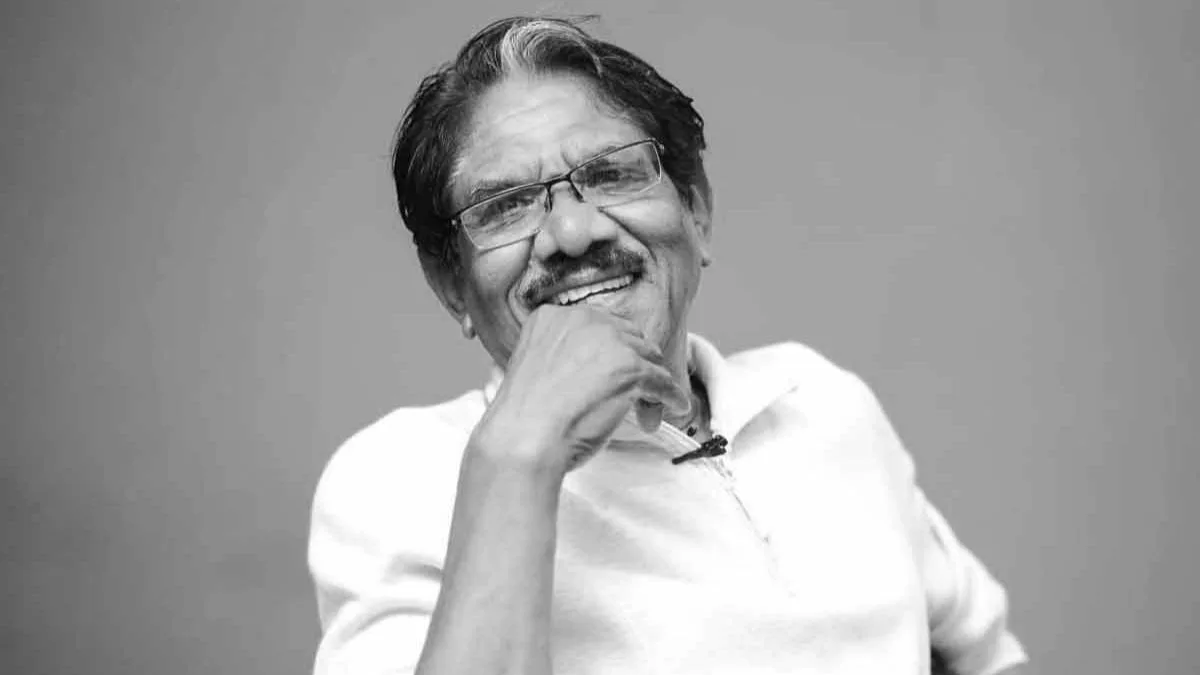
A trailblazer in Tamil filmdom, iconic filmmaker Bharathiraja, who passed away on Wednesday, took the celluloid industry, which till then was kept chained to the studios, to the countryside, bringing a fresh breeze and a new wave through narratives, highlighting the social dynamics of caste, religion and gender that remained unexplored.
He was 84 and is survived by his wife and a daughter, while his son, actor Manoj, predeceased him. He was indisposed due to age-related illness and was confined to his home.
Advertisement
A six-time national award winner, Bharathiraja had the gumption to present a bare-bodied Kamal Hassan as the limping innocent Chappani, only with a loincloth in a sequence of scenes, in his very first directorial venture ‘16 Vayathinile’ (16th Year – 1977), in a rustic village setting. With Sridevi, presented throughout in the now-vanishing teen dress of davani and skirt, as the female lead, and Rajinikanth as the archetypal villain with his signature imprint, the movie turned out to be a huge hit at the box office, and the film’s numbers are highly popular even now.
From then on, there was no looking back, and his films hit the silver screen like wave after wave. While the theme and storytelling were captivating, the titles too were poetic like Alaigal Oyvathilla (Ceaseless Waves), Kadolora Kavithaigakal (Sonnets of the Seashore), Niram Maaratha Pookkal (Flowers that do not Change Colour), Man Vasanai (Fragrance of Soil), Vetham Puthithu (A New Veda), Muthal Mariyathai (First Respect) and so on.
Besides changing the language of cinema and redefining the genre, he has presented the countryside in all its facets, patriarchy and feudal relations, the fertile (Vedam Puthithu, Muthal Mariyathai), as well as the dry rain-shadow landscape (Karuthamma) of the southern districts of Tamil Nadu. In his films, nature is integral to the narrative, not a mere background, but a living entity, adhering to the ancient Sangam era foundational classification of landscape for akam (love) and puram (exterior).
Though credited with infusing the Tamil celluloid world with the beauty and serenity of village life, together with the tensions therein, he has presented urban life with aplomb in the Kamal Hassan-Sridevi starrer ‘Sigappu Rojakkal’ and Rajinikanth’s ‘Kodi parakkuthu’, as well as Kamal Hassan-Radha combo in ‘Oru Kaidhiyin Diary’.
Hailing from a small town, Allinagaram, in Theni district, he had an innate grasp of the rural hinterland, its politics, prejudices and problems. And, last but not least, his film career would not have reached the pinnacle but for his childhood buddy, maestro Ilaiyaraja, who scored for most of his films. The combo was terrific, and the magic will continue to live on, though time has taken one of them.